Showing posts with label card games. Show all posts

Tuesday, June 9, 2026

What We’re Playing: Tabletop H through W

The upper end of the alphabet leans into games played with friends who prefer casual fare.

Hot Streak

Four hapless lower league baseball mascots race. You place your bets and contribute a secret card to help your wagers. Ridiculous silly fun playable by almost all ages and all but a few temperaments. This Boardgame Geek introduction sums it up.

Legendary: Game of Thrones

One of my designs, turning Devin Low’s wonderful semi-cooperative Legendary deckbuilding system into a fully competitive cutthroat contest between rival houses. I’m happy with how gameplay worked out and I’m happy with hand-painted card art, one artist per great House. Not as happy with an oddity of the game’s production, that somehow put terms on the playmats that don’t correspond to terms used during any stage of the game’s development.

Huh.

I got interviewed about the design of the game and the video eventually showed up on Youtube when I wasn’t looking. Here’s a link to that interview, featuring me blinking in and out of my very fancy background.

Richard Garfield’s Carnival of Monsters

This is another game that works well for most of the casual gamers we know. The land = buying power feels a little like M:tG but it’s a drafting game, pick one card and pass the rest on, trying to give a fickle public the monster shows they want to see that season. I think the game might have sort of fallen between the cracks because it had a flawed crowdfunding campaign that got called off. Published as a normal game, it’s fun and replayable.

Our favorite moment playing the game came from a game with Jonathan Tweet, who wasn’t paying careful attention as we began. As we played he grew increasingly complementary about several clever mechanics. Normally he is not impressed by many games, so this was a change of pace. The third time he thought something was really smart he said, “This is really well designed. Who did this?” Lisa got to lean forward and say, “Jonathan. The name of the game is RICHARD GARFIELD’S Carnival of Monsters.”

Sanibel

This is Elizabeth Hargrave’s new game of tide walking and shell-collecting. I’m not sure I’m the target audience for the game. People who like to organize things? Our house is full of wonderful talismans and we’re not the folks who need them organized. I suspect I’m going to give the game to friends like Lee Moyer and Venetia, since the collection/arrangement patterns of the game seem like their happy place.

Three-Dragon Ante

We’ve been playing a version of the game with a deck made of favorite dragons and mortals. It’s easy to bring out when visiting non-gamers or casual gamers say they want to try one of my games.

At the moment the only version of the game that’s in print is the Giants War expansion. I’m hoping to get the core game back in print soon.

Unidentified New Card Game

We’ve played a new card game of my design five times with different groups and it’s working great. Next steps: business related.

Hmm, that makes the process sound a lot quicker than it was. Depending on how you count, this final version of the game is the 5th or the 6th draft.

Wingspan

We still play this game with mostly North American birds, because Lisa uses the game partly as ornithology practice. I’m optimistic that we’ll be able to play a game with the Central and South American hummingbird expansion soon!

Tuesday, June 2, 2026

What I’ve Been Playing: Tabletop A Through F

Here are notes on games I’ve played in the past couple months, with game design comments where appropriate. Covering four games at a time means there’ll be a follow-up or two.

I didn't intend to begin with two of my own games but such are the gifts of alphabetical order.

13th Age

We’re getting close to the end of epic tier in the Teachers from the Court campaign that’s mentioned several times in 13th Age 2e. We started the campaign to test the living dungeon Jonathan wrote as the intro adventure at the back of the Gamemaster’s Guide. We liked our characters and wanted to keep playing so Paul Hughes transformed the dungeon run into a full campaign. Early in adventure tier, we posed as instructors from the Court of Stars sent to educate the half-elf children of our primary contact. We needed a cover-story because we’d entered a contested zone where the forces of the evil Diabolist/Archmage visited the town for supplies. ‘The Teachers from the Court’ became our nom de guerre, even after we’d qualified for several other higher ranking titles in the Elf Queen’s service.

When we don’t have a full crew, I’ve been running my deviant Arduin game, 13th Arduin, aka Arduin, Blessed Arduin.

And I’ve run a couple one-shots lately for diverse groups, one of them using the two-hour freeform adventure you can find here.

Armello: The Board Game

This gloriously beautiful board game from King of the Castle games shipped to all its kickstarter backers a couple months ago. It’s based on a digital game I like to call ‘the national game of Australia.’ With the help of an excellent development/playtest team, I reshaped the original digital game’s mix of quest movement and funny-but-serious-animal combat into a deckbuilding quest and combat game. Each of the four heroes has its own starting deck and powerful experience cards. Your hero gets more powerful by buying action and combat cards from the marketplace and winning treasures by finishing quests that send you criss-crossing the board. Unlike some deckbuilding games, that pretty much let people play their own solitaire games side-by-side, Armello: the Board Game rewards players who mix it up with their opponents.

One of my biggest reasons for designing the analog version of the game as a deckbuilder is that I dislike the way Armello’s beautiful cards are used in the video game. Some cards get played for their full effect, but a whole lot of cards in the video game are discarded to use the symbol that’s on the card in combat. In other words, you read the card, you decide it’s not something you need to play, and you discard it to get a hit or a shield or a save. When a game has beautiful and evocative cards, I like to try to make those cards matter. In this case, deckbuilding mechanics that bring cards through your hand multiple times did the trick, and opened a huge amount of design space. You’ll see my attitude towards cards that should matter surfacing again, below, in comments on Finspan.

I’m answering rules questions on BoardgameGeek, helped by savvy players. I’m not sure when there will copies going through distribution, but for now you can aquire the game by going through the Backerkit page as a 'pre-order.'

Dead Man’s Hand

My Desperadoes faced off against Chris Pramas’ Lawmen a few weeks ago. It was an appropriately desperate tie and a very fun skirmish miniatures game. I love minis games but neither paint minis nor invest in terrain, so it was good that Chris came prepared. We also used a couple buildings from a paper Belgian village that I used as terrain all through my childhood. Chris has now invested in a proper Dead Man’s Hand box, and we’ll definitely play again, probably with different factions.

Finspan

I quite love Wingspan. So does my wife Lisa. So do our ornithologist friends!

Lisa also loves Finspan so I’m going to need to relax my critical spirit and just-enjoy the good parts.

My disagreement with this iteration of the system is that you pay for most fish by discarding other fish from your hand. Yes, it’s that problem again, the same type of objection I have with the digital Armello cards. I’m looking through all my beautiful cards and constantly grading them, only a couple deserve to be played, the others will be discarded . . . and possibly returned to my hand if I get that type of engine working.

Discard-to-buy annoys me. Maybe it doesn’t annoy other people. I'll give it another try and whine less.

Monday, November 17, 2025

Skill & Strategy in Legendary: Game of Thrones

Despite the subject line, today’s blog is not a strategy guide! Instead, it’s a look at a couple of cards from the about-to-release Legendary: Game of Thrones showing how I redefined two Hero classes whose names make sense in superhero games but don't apply as well to GRR Martin's fantasy world.

Legendary uses five card classes, aka colors, to define the heroes of all the various Legendary deckbuilding games. The five colors are Tech (Black), Ranged (Blue), Covert (Red), Strength (Green), and Instinct (White). It’s the first two classes—Black and Blue—that needed to be redefined for Game of Thrones.

Blue is for Skill

Ranged (Blue) is about blasting things, usually with energy beams, lightning, lasers, psychic powers, and so on. Yes, Daenerys’ dragons could muster convincing energy attacks, and there’s at least one flaming sword in the world, but ranged/energy isn’t a rich source of character concepts in GoT. I called Blue “Magic” when I designed Legendary: Big Trouble in Little China, but that’s not right for GoT either, where magic is usually hidden and covert instead of showy and explosive.

So I went with a concept that’s extremely important to the great Houses and their warriors: Blue is now Skill. “Skill Heroes (Blue) have prowess with weapons and combat, especially the combat styles practiced by trained warriors and knights.” It’s not about brawn, it’s not about instinct, it’s about skills recognized by other great knights, like the skills possessed by Loras Tyrell, who shows up as a Skill Hero on one of the cards from the Great Warriors hero set.

Two of Jaime Lannister’s cards are Skill cards, including one of his two common cards, Kingslayer.

Jaime’s defining act, earlier in his career, is so infamous that everyone expects him to do his worst. That’s how I think of the part of the card that forces you to choose an enemy to draw a card, Jaime has a bit of a deathwish and he’s a provocateur. In a two-player game you obviously know who’s drawing the card, it’s in multiplayer games that the lobbying becomes interesting, though you’re usually attempting to help the enemy who seems like less of a threat.

Meanwhile, Sword Mastery is the GoT set’s version of the Conqueror ability. If there’s any Ally in the Sword range-space, the space in the middle of the range track, Kingslayer provides another +2 Attack that can only be used against Masterminds. Since Kingslayer is a Common card, you might draw multiples in the same hand. When Sword Mastery triggers, an enemy Mastermind tends to follow the King into oblivion.

Black is for Strategy

The other card I’m showing today is the rare card from Jaime Lannister. It’s a Covert (Red card) that plays on the connection between the Lannister twins. They’re so intertwined that Cersei is showing up on Jaime’s Rare card!

The Strategy trigger on Intertwined is all Cersei. And Strategy is what Black has become instead of Tech in GoT. The series’ opening credits have some wonderful tech, but I wouldn’t say there’s much tech to build Hero cards with. So I went with a quality that sets many of the most deadly characters in GoT apart:: “Strategy Heroes (Black) use big-picture manipulation, grand strategic and master plans.”

Cersei is the poster ‘hero’ for Strategy cards. Intertwined’s Strategy trigger offers an unusual amount of choice in how you’ll use the effect, but the story concept is the same: someone is being removed from the big picture.

As you’d expect, Tyrion is another Lannister with Strategy in mind. The Small Council of the Baratheon House has some Strategy cards, but there aren’t as many in the Stark and Dothraki houses. In fact, one of the Stark Masterminds gets weaker when attacked with Strategy cards; Lord Eddard the Hand wasn’t playing the long game.

Thursday, November 6, 2025

Legendary: Game of Thrones, Releasing Soon as a Cutthroat Card Game

I love the Legendary deck-building game designed by Devin Low! Lisa and I were in the same city as Devin when he made the original edition, so we got to playtest as the game took shape. Since then Devin has designed something like two dozen sets of various sizes and Upper Deck has adopted the system for a multitude of film and television properties.

I’m still most fond of the freeform Legendary approach, where stories you tell yourself grow out of deckbuilding, instead of the guided storytelling of the Legendary Encounters boxes.

I designed a Legendary set a few years ago, sticking close to the original model but filling the Big Trouble in Little China set with the dynamics Lisa enjoyed—game design as gift. And now I’ve designed Legendary: Game of Thrones, in partnership with Warner Bros. Discovery Global Consumer Products and HBO, coming soon to local game stores!

The challenge posed by Legendary®: Game of Thrones was to turn a competitive co-op game into a cutthroat battle. In Legendary; all players are heroes, competing to be the best at defeating villains. The heroes win together or lose together, but one winner is more equal than others. Well, a lot more equal, but when players take selfish actions that screw the other players, many tables point out that ‘we’re all supposed to be on the same side.’

That doesn’t make sense for Game of Thrones. Game of Thrones needs to be an epic battle where no one blames you for using powers that hurt your opponents. It’s a battle with one House winning.

I’m going to introduce a few of the mechanics that combine into direct battle in a series of blog posts, starting today with a note about each player’s Hero line-up.

Your own Hero line-up: Let’s take the simplest case, a two-player game, Starks vs. Lannisters, using the Full Allegiance starter game so that you’ll each use all four of the Heroes from your House.

If you’re playing the Starks, you want to buy Stark characters for your deck. Playing with Lannisters in your Hero hand would feel all wrong. So, as a rule, you don’t. Instead of a single shared line-up, where all players compete to buy the Hero cards they want from a common pool, each player has their own line-up of five Hero cards. It looks something like this, to switch Houses for a moment and show the King's Landing player board that is part of the game’s initial image releases:

Adding Pressure: If you were the only player able to buy cards from a Legendary line-up, you’d have a low-pressure opportunity to acquire more and more of the cards you want. In other Legendary games, you have to keep track of what opponents are buying and hope they don’t take the cards you want.

Legendary®: Game of Thrones has card interaction that makes you care about what cards your foes buy, but the key dynamic of putting some time pressure on Hero purchases from your own line-up is handled with a new mechanic: Events.

A random assortment of 16 different Event cards (there are 2 copies of each) is shuffled into the single central Allies deck, the deck of antagonists that your Heroes defeat or support, depending on their House. At the start of each player’s turn, they draw a card from the Allies deck, exactly like drawing a card from the Villains deck in the original version of the game.

If you draw an Event, the first thing everyone must do is Cycle a card out of their own line-up. Each Event specifies the space the card is cycled out of.

Here’s an example: Escalation. Before resolving its text, every player has to take the card out of the third space of their line-up, the center-space, put it at the bottom of their personal Hero deck, and replace it with the top card of their Hero deck. It could be the lousy little card you don’t want to see again, or it could be cherished 7-cost rare that you’d already started building your hopes around.

And then you get the fun of the Event text! Escalation shakes things up because it lets everyone interact with their line-up at an unexpected time. Even if the card you really wanted was in your third space, you’re still generally able to improve your deck somehow.

Of course, not all Events are helpful. But playtesting gradually winnowed away the Events that were just hurtful. Your Heroes and your Allies that are in the central Ally deck are going to hurt your opponents plenty; Events are now most often interesting effects that can affect multiple players.

Friday, March 29, 2024

Armello: The Board Game

It’s March 29, 2024, and I’m in the kinda unique position of reporting that a game I had a blast designing has already made a treasure-trove on Kickstarter and still has about a week to roll. It’s Armello: The Board Game, a deckbuilding adventure board game of furry animal heroes with swords questing to take the throne from their corrupt King . . . over each other’s (temporarily) dead bodies!

Armello: The Board Game is being published by friends at King of the Castle, aka the wonderful creators of Campaign Coins. I’ve been writing occasional design notes you can find in the Kickstarter page’s updates and the game has just hit a stretch goal where I’ll loop back into the game to design two fistfuls of magic Amulets. It’s time I stepped away from an all-out push to finish 13th Age Second Edition’s next playtest packet to talk about the game that’s already being crowdfunded!

This board game version of Armello inherited a huge trove of goodness from the earlier digital game from League of Geeks. The digital game originally featured on Kickstarter and was supported with new cards and hero clans and game expansions for many years. Hundreds of beautiful cards, cool custom dice with magical symbols, and cutthroat anthropomorphic animal heroes on a quest to usurp a Corrupt king has translated into a competitive deckbuilding quest-and-combat boardgame . . . though ‘translated’ isn’t the right word. I aimed to create a game in a new medium that captured the spirit and evoked the feel of the original.

Digital games can do a lot of things that aren’t repeatable on tabletop. Then midway through the design, I turned the digital game’s more traditional style of cardplay into a deckbuilding experience. Partly that’s because I love deckbuilding games. And partly it’s because deckbuilding felt like a great metaphor for character growth and experience. Each hero has their own unique starter and experience decks as well as cards they can buy from the market or win as treasure.

There are six days to go for the Kickstarter, plus some time in the post-crowdfunding phase. I’m not sure I’ll be designing for more stretch goals, but I do know that the design note I just wrote talks about a possible expansion.

If you do nothing else, check out the cool Kickstarter video! When you play the digital game, you’ll recognize the narrator as the voice of the King.

Saturday, December 3, 2022

Three-Dragon Ante: Giants War Notes & Variants

Three-Dragon Ante: Giants War is an expansion of Three-Dragon Ante, just out from WizKids. (Earlier blog post here.) The set plays off D&D’s story of an ancient war between dragons and giants. Most of the new cards are based on D&D’s familiar giants: frost, fire, storm, stone, hill, and so on, along with Giant God cards for the bigger-than-I’d-originally-remembered giant pantheon.

You need the original 3DA set to play using Giant Wars, because every gambit awards one stake to the strongest dragon cards and the other stake to the strongest giant cards.

Time & the Endgame

Three-Dragon Ante has always played differently with different numbers of players. With two stakes that can be won each gambit, instead of one, Giants War increases the distinctions between three-player, four-player, and larger games.

So far, in my experience, three-player games are the most likely to invoke the variant end game. If no one has won after you’ve run out of cards in the main deck and shuffled in the middle game, score three more gambits and end the game after the third gambit’s toast. To win a three-player game before the toasts, you sometimes need to push the ante heavily instead of giving opponents time to recover. That’s true in all forms of 3DA, and more true when there are three players and two stakes per gambit.

Even if you’re not playing 3DA as a drinking game, I recommend raising beverages as you toast these final three hands. And if you’re making the toasts aloud, the final toast echoes better as “To fools like us!”

Variants for One-Stake Games

If you want to play a straight 3DA game with just one stake, all three of the new dragon suits will work so long as you shuffle the Mortals and Legendary Dragons (including the new Io and Shadow Invader) into a separate Legendary deck at the start of the game. You’ll need to play with either or both of the new Copper Dragon and Gold Dragon or the Legendary deck will be untapped. The new Gold Dragon from Giants War will always get to draw a Legendary card as long as someone else has played a card in the gambit, but if you lead with the Gold Dragon, you’ll only get a regular card.

I haven’t tried this variant. It seems like the Legendary deck will be kind of slim without all the Legendary giants, so I believe you should skip shuffling cards from the Legendary deck into the main deck at the start of the game.

If you’d rather play strictly with dragons and the original 3DA rules, skipping the Legendary deck, the new cards to add to the game are Io, the Shadow Dragon suit, and the Shadow Invader.

Both the new mortals—the Emperor and Ranger—will work in either variant. In fact, they’ll be more powerful than they are in Giants War games.

No Emperor’s Gambit

And speaking of the Emperor, yes, this is a very different version of a card that was at the core of the Emperor’s Gambit expansion for the original version of 3DA.

People often ask if the Emperor’s Gambit set that WotC published in 2010 going to be reprinted or revised. I’m pretty sure the answer is no, because hardly any of the dragons that were the core of Emperor’s Gambit have been brought from 4e forward to D&D 5e. 3DA licenses D&D’s dragons. Even if one or two of the iron, adamantine, mercury, earthquake, etc. dragons that populated 4e show up in 5e, I doubt the rest will appear.

So while we wait for dragons that probably aren’t going to show up, I’ve recruited some of the characters and mechanics from Emperor’s Gambit, including putting the Earthquake Dragon’s heavy-roller power on the new Fire Giant.

The Start-Small Variant

One more variant before I go, which started as an accident when I forgot to shuffle cards from the Legendary deck into the main deck at the start of the game!

Instead of correcting the mistake and re-dealing, I thought about it a second and decided it wasn’t bad to start everyone out with normal cards as their first hand. It feels a little bit like the “no dirt on the first trick” rules that some people use in Hearts. So, the Start-Small variant rules that you shuffle the 6 Legendary cards into the main deck after each player has been dealt their starting 7-card hand. Yes, ‘dirt’ in the form of a Legendary card might show up as you draw cards during the first gambit, so that’s a tiny bonus for people playing to draw.

Monday, November 21, 2022

Speeding Up, Letting Go, What the Hell

For a person who always loved games, it took me too long to learn that I'd be able to play more often if everyone enjoyed playing with me. I wasn't a bad loser, or an intolerably bad winner. I was just soooooo slow. I played "well" because I analyzed all options and wasn't quick about it. When my wife Lisa started talking about using a timer, or just not playing some games with me, I got the message.

These days I work at playing quickly, carving off a couple slices of analysis and putting the rest in the "yeah, things might get messy there" bucket. It's not always easy just-letting-go, and sometimes I have to roleplay reasons that I'm not going to work hard at being clever.

For example, playing Lanterns, I limit myself to a one-minute turn, and the last game I played when it felt like I might be making a mistake, I said something like "Well, we dropped the oars and were scrabbling around in the bottom of the boat when we should have been lighting lanterns. So we've gotta dump the lanterns overboard before the boat catches on fire, now!"

Playing Commands & Colors: Samurai Battles for the first time a couple months ago, I played from the beginning saying that my commander was nursing a bad hangover. Did a good job of roleplaying that too, since I ended the game by charging disastrously with the wrong unit, snatching defeat from victory. Ee ja nai ka!

Playtesting new games with skilled designers and tournament players, I sometimes run into a variant of the same problem. Even in their first game, players who don't really understand the rules yet tend to want to analyze everything instead of just-playing-through.

So I've recently been starting introductory boardgame and testing sessions with roleplaying advice: "Pretend we're drunk! We're not going to get everything right. You don't know the system and I'm not gonna do a perfect job explaining things all the way through, so you won't make the right decisions, let's just plow through and if something goes wrong, well, it's my fault, what the hell!"

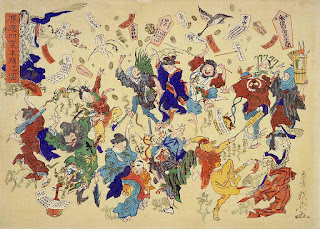
[[art by By Kawanabe Kyōsai - National Diet Library Digital Collections, Public Domain, https://commons.wikimedia.org/w/index.php?curid=2183868

Thursday, July 28, 2022

Storybook Brawling onto a Tabletop

The art above is called Flights by Moonlight. It’s the first storybook image we got from our amazing artist, Ekaterina Chesalova, for the Storybook Brawl boardgame I’ve been working on the past year with designers from my company, Fire Opal Media, and other designers from Good Luck Games.

One of the coolest things about designing games is that sometimes the games you play turn into games you’re working on. In 2021, I was playing a lot of Storybook Brawl, the digital auto-battler-style game of twisted fairy tales on Steam. I knew some of the designers. I loved the game. My business partner Jay Schneider and I got in touch and we ended up signing on to design a board game version of Storybook Brawl!

If you’ve played the digital version, you’re probably aware that most of the mechanics that make the digital version tick don’t translate into a board game. The truth is that it can be liberating when mechanics are so untranslatable. We had to evoke the feel of the digital game, and the fun of its brawls, in a board and card game environment that would stay fun for players of many ages instead of gradually eliminating people until only one winner was left.

I love this type of challenge!

Sometimes my early designs are reasonably close to the final design. This was not one of those times. Jay and the rest of the development team did so much work and redesign, and along the way we realized that the way to set up the brawls at the heart of the game was with a storybook that would double as a scenario guide!

The Flights by Moonlight picture above? That’s one of the early scenes from Act II: Home Realms, showing the moment Mrs. Claus and Pan’s Shadow meet after their stories have been shuffled together. The storybook’s opposite page gives each player a choice between three Plot Twists before that round’s brawl: Workshopping (just some gold to buy better cards); From Up Here, Everybody Else Looks Tiny (the right to buy cards from your shop for a tiny price this round); and Moonlit Reconnaissance (banishing a random card and acquiring two new cards).

Yes, it’s a deckbuilding game of sorts. And each brawl leads to another story later on in the storybook, until the grand finale. I’m thrilled with the game and in love with writing storybooks for it! It’s one of those games I’m going to struggle to keep a copy of because my wife Lisa is gonna be giving it away as a gift. (Seriously: I’ve had to borrow copies of Three-Dragon Ante and Epic Spell Wars from friends because all of our copies had been gifted!)

The Storybook Brawl board game is going to be published by Dara Studios. It will go on Kickstarter later this fall. Come by booth 2400 at GenCon next week to see a prototype, check out the storybook, and to play a demo for between 2 and 4 players.

I’ll usually be at the Pelgrane booth, #423, and though I’m mostly doing 13th Age things there, I’ll be happy to talk about Storybook Brawl and will probably be at booth 2400 running/playing games now and then.

I’ll post in the next couple days about the Pelgrane-and-other-things I’ll be up to at GenCon.

Monday, April 4, 2022

Three-Dragon Ante: Giants War

Ante again! Some time around July 2022, WizKids is releasing my sequel to Three-Dragon Ante: Legendary Edition, a 100+ card set called Three-Dragon Ante: Giants War.

This new set of blue-backed cards introduces 4 colors of good giants, 4 colors of evil giants, 3 colors of dragons, a full pantheon of giant god cards, and rules for fighting for a giants’ stake and a dragons’ stake each gambit. (Hint: you only score your flight for the stakes you are strongest in, so feints and strategy-shifts abound.)

The backstory of the game is based on the Thousand-Year War between the giants and the dragons, back when the world was young. The history of the war appears on page 19 of Volo’s Guide to Monsters. Short version: the giants lost their world-spanning empire. The game might be a bit of a sore spot for the giants. . . or maybe they like the reminder that they were once in charge, and could be in the future?

I’ll have more updates later. For now, let’s go through the three cards shown in this preview image!

Frost Giant: One of the four colors of evil dragons, of course. Relishes competition, when its power triggers you collect gold from anyone else competing for the same stakes. If you’re playing first in the gambit, or slipping in to try and take a stake without any competition, you’re not giving the Frost Giant the fight it wants, so it won’t earn you any extra gold.

Surtur: Yes, the set comes with the full pantheon of giant gods! The giant gods, dragon gods, legendary giants, legendary dragons and legendary mortals get shuffled into a single Legendary deck at the start of the game, with six cards from that deck shuffled in with the normal deck of giants and dragons. Many cards’ powers let you draw a card from the new Legendary deck, so there’s a decent chance that Surtur might be competing with other gods. He’s worth at least +2, a total of 12 for the Giants, if his power triggers, and when your opponents are taking a gambit seriously he could be worth more.

Copper Dragon: A new Copper Dragon card! The original Copper Dragon is still great for games that don’t use giants and the Legendary deck. But the original Copper Dragon power, that adds a random card to your flight and triggers its power, is not much fun when you’re carefully managing which stakes, dragons or giants, you’re fighting for. So the new version plays off the Copper’s gregarious nature—your weakest opponent gets to draw a card, and then you draw a card from the Legendary deck. This type of sympathy for the weak isn’t the type of thing the new giants cards go in for, but you’re fighting for the dragon stakes and maybe setting yourself up with a power card.

Thursday, January 28, 2021

Wrestlenomicon: Cultist Rules


(all art from the wild pen of Kurt Komoda)

I’d always hoped to add servitors of the elder gods to the game, cards that would have the same card backs as Cultists. When we started the Kickstarter, I presumed that new Cultists would be a project for the future. But the future arrived during the KS. Shane and Dennis found a way to add The Dead to Hastur’s Cultists and recruited the Deep Ones for Cthulhu. Kurt handled the art, I did some mechanics, and ta-dah, mission accomplished. But maybe I missed a step: I didn’t adjust the Cultists paragraphs on page 13 of the rulebook to account for these KS-exclusive cards. Some people have asked about it.

So here’s a rewording of the rules to account for the new Cultists. I’m going to phrase these rules to reflect the way I use the Cult tile, which is different than how the rulebook recommends using it. I’m also not going to use the terse style that saves space in a rulebook. This will be wordier.

Cultists

Cultist cards are in a separate category from the other cards in the game, distinguished by their own card back to prevent them being mistaken for cards that are part of your normal deck and your normal hand.

Before the game, shuffle your Cultist cards and place them face-down as a separate Cultist deck on your Cult tile. Use as many Cultist cards as you have available for your god. (For Kickstarter backers who bought everything, Cthulhu will have 8 standard Cultists, 5 Willing Sacrifices, and 5 Deep Ones. Hastur will have 8 standard Cultists, 5 Willing Sacrifices, and 5 The Dead. If you’ve ended up with fewer Cultists than that, don’t worry, just use what you’ve got.)

Neither player starts with any Cultists, but some cards can grant them to you. When you gain a Cultist, draw the top card from your Cultist deck and keep it on the edge of your hand of cards so that it doesn’t get mixed up with the rest of your normal hand of cards. Given that there’s not a lot of text on the Cultist cards you’ll need to refer to often, my method is to turn them upside down so I don’t confuse them with the cards that are officially in my hand. You could even just turn them backside up so that all you can see is the Cultist card back. Because a Cultist card doesn’t count as a card in your hand, you’re just holding it with the rest of your cards to keep track of it as an available resource. If you feel like setting it somewhere else, go ahead! There’s no limit to the number of Cultists you can accumulate.


(upside-down Cultists on the left of a three-card Cthulhu hand)

When you sacrifice a Cultist, place it face-up into a separate Cultist discard pile. You should have room on your Cult tile for both the Cultist deck and the Cultist discards. If you ever need to gain a Cultist and don’t have any left in your deck, reshuffle your Cultist discard pile.


(using the Cult tile as the spot for a Cultists deck and discard)

The full rules for each type of Cultist are printed on that card. In other words, if the Cultist in your hand is one of The Dead or Deep Ones, you won’t be able to use it for the standard Cultist sacrifice.

When you use a standard Cultist or one of The Willing Sacrifice bonus art Cultists, Cultist sacrifice works like this: When you advance an attack on your track (using Momentum), you can sacrifice one or more Cultists you’ve gained earlier to move that card an extra space for each Cultist sacrificed. (If you move multiple cards due to exclamation point momentum, each Cultist sacrificed moves a single card.)

At the moment the Willing Sacrifice cards don’t accomplish any more than the normal Cultists . . . aside from the possibility of making a mid-game sacrifice of a loved one (or the first friend I played D&D with) who strongly supported our Kickstarter! But when the game has expansions down the road, we’ll find a way to add some zing to the Willing Sacrifices.


Saturday, April 11, 2020

Playing Three-Dragon Ante Across Two Zooming Tables

Last night we played four-player Three-Dragon Ante in two households. We played with Ann and Rob Dorgan, friends you'll find in the 3DA: Legendary Edition playtester list. Ann pushed past my qualms and we tweaked the game on the fly. 

If you feel like playing 3DA across multiple physically isolated tables, here are some recommendations for a two-table game.

First, I think you need at least two players per table. The ideas that follow assume you don't have any single-player tables mixed in.

Tracking Gold
You're going to need to figure out how to keep track of everyone's gold across split tables. We dared to maintain the game's physical presence by creating stacks of gold for the players across the Zoom-divide and moving gold in and out of both stacks, banking for the players who weren't in the room. It worked, usually, but we clearly weren't entirely up to the process, the game is too distracting to perfectly track coin-movement for players who aren't in the room. So if we do it again, I'm going to vote to have a banker who will keep track of all gold, probably on a google doc or the like, though it could be on paper.

Gameplay
Unless otherwise mentioned, the normal rules work! (But tell me if you play and run into issues we didn't.)

Deck Preparation
Each table creates its own deck using the 70 standard cards and 10 random Legendary cards. Yes, the game could end up with two Druids, one per table!

Camera Set-Up
Set up the cameras and computers so that the flow clockwise around each table matches the positioning of the video of your friends in the far room! It needs to be obvious which players are on your left and right, everyone will have one side occupied by a player beside them and one side occupied by a player in the other room, unless a table has a third player sandwiched in between.

Strength Flights
Go ahead and let Strength flights pick up the ante cards at their own table, if any. If there aren't any left, that's too bad.

No Stealing or Gifting Cards Across Tables
The specific card power revisions below nearly always hinge on the fact that we aren't stealing or passing cards from one table to the other. A power that's going to steal a card from the player next to you at your own table can work the same as ever, but if the card would steal from a player in the other room, it's going to have a slightly different effect.
    The card revisions that follow also apply to Legendary versions of the same powers.

Brass Dragon: If the player to your right isn't in the room, they just give you the gold instead of having the option to hand over a stronger good dragon.

Bronze Dragon: Take the weakest card from the ante at your table. Then draw a card. If there are no cards left in the ante at your table, just draw a single card.

Green Dragon: Same situation as the Brass. If the player on your left is in the room, they can choose what they want to give you. But if they're at the other table, they just pay you the gold. The Green Schemer's left-and-right version of the ability can end up with one opponent being forced to pay and one opponent getting to choose.

Red Dragon: If the strongest opponent is at the other table, they must discard a random card. Well, let's be clear: the opponent next to them chooses a random card from their hand and discards it, because that's more aggressive, like stealing! For fun, everyone sees the card that got discarded. And then you, the player who triggered the Red Dragon, get to draw a card and keep it secret.

Illusionist: Maybe don't play with this one!  This card is all about the fun of swapping Mortals and it's hard to swap across tables, so I'd say you should feel free to skip it, take it out of the game before you choose the 10 random Legendary cards. But if you do play with it, and are prepared to hurt your brain just a little, you could say that it works normally if you swap at the same table . . .and if you swap to the other table, then you all have to use your virtual reality parallel-thinking skills to swap the Mortals for the duration of this gambit. At the end of the gambit, the two Mortals go their tables' discard piles as normal, but for part of a gambit you were caught in the ill-uu-shee-on.

Tuesday, March 17, 2020

Guest Post: Tweet's Projects

Since Jonathan Tweet is temporarily between blogs, he occasionally posts on game design here. He's something of a minimalist so I added italics and boldface.

Jonathan says. . . .

Here’s a list of my current projects, from a game that’s done and in the publisher’s hands to games that are just in the beginning stages of design. I always have several projects “live” at a time, although sometimes a single project takes over most of my schedule. Over the next months and years, here’s what you might see from me. 

Design complete: A science-oriented kids’ game with a new publisher. 

Largely complete: Sourcebook for a new publisher, offering a new take on a well-loved setting. 

Design underway: A new edition of Everway, where I can apply what the free-form roleplaying game design community has learned and invented over the last 25 years. Working with the Everway Company, comprising people I’ve known since Everway’s debut. 

Underway: Monthly 1,000-word essays about my history in RPG design, posted on EN World. 

Underway: Sourcebook for another new publisher, also offering a new take on a well-loved setting.  

Underway: In the tradition of Grandmother Fish, another lovable picture book that teaches evolution science to pre-schoolers. 

Maintenance: Every year, I update the content of the game-design course I teach each fall through the University of Washington. 

Beginning stages: Head-to-head card game. Latest brain storm. 

Beginning stages: A story-oriented supplement for 5E with a new publisher. 

Beginning stages: Possible relaunch of a quirky trading card game from the 90s. 

Back-burnered: Non-fiction book, Jesus for atheists

Friday, January 24, 2020

Gaming this week: Book of the Underworld, Wingspan, Cypher System


The wonderful car-web photo above was taken by Lisa Eschenbach, and I'm using it to acknowledge that I finished the development phase on Gareth Ryder-Hanrahan's Book of the Underworld earlier this week. Yeah, it took a few weeks longer than I expected. The book is now with the editor. All the art is coming in on schedule so it won't be too long before it's in layout.

Also this week, I made huge progress on two new designs. The secret card/boardgame I've been designing for my own personal satisfaction has achieved harmony. Players have been enjoying it for awhile, and now I'm also simply having fun rather than seeing things that need fixing. Notably, I'm no longer winning every game. There's a specific type of imbalance when the designer's advantage in knowing what might be unbalanced pays off too often. Happily, I'm losing now, so that development phase is over.  I'll be looking for a publisher soon.

Meanwhile on a different unannounced boardgame project that has a publisher already, I solved the last of the design problems that was bugging me and am making a pass through the cardset and other components to live up to the new solutions. I'm looking forward to playtesting next week.

I also enjoyed a couple first-plays this week. I've only been able to find the European supplement for Wingspan, but friends Brittany and Miguel brought over the core game. We all loved it. Lisa used the Audubon app on her phone to accompany turns with the calls of the newly played birds. Brittany arranged a ridiculous combo and stuffed what she called a 'Christmas goose' with 20 VP, so curses accompanied the bird calls.

I also got to play my first game of the Cypher system, in a highly diverting fantasy genre session run by Bruce Cordell. I had fun as a Resilient Speaker Who Keeps a Magic Ally. Specifically, I'm playing a priest of a war god that died in apocalyptic fashion (the god I mean), and now I get my spells from random deities, changing every day, who are using me as an experiment, or a bet, or something. More or less a One Unique Thing that will definitely make for fun prayers. Also: I'm a kite-fighting and bocce ball aficionado. My comrades are considerably doughtier (more on them next time), so all shall be well.

And though we didn't play The Gods War this week, it launched a Kickstarter with Gloranthan gods of War, Secrets, and Magic, and I'm pretty sure I never shared this method-acting photo from our Gods War game. From right to left, Sean pulled faces as Chaos, Jonathan was a stickler-for-rules Solar, and I was a Storm player who never rolled a 6 after mistakenly using a wargaming plan in an area control universe. The sword was an attempt to compensate for 6-less-ness. Paul, the Darkness troll photographer, ate us all.


Tuesday, December 10, 2019

Wingspan: Vote of Confidence


For about 36 hours, I owned a copy of Wingspan. I taught the game to a nine-year old who coincidentally shares his name with a bird. That's his younger sister on the left, she realized the game was too much for her and instead she gleefully punched out birdfoods. When the nine-year old loved the game as much as I did, he took it home to his nest.

Monday, November 18, 2019

New 3DA ability and archetypes for tournament play

WizKids is running Three-Dragon Ante tournaments on Friday and Saturday of PAX Unplugged in Pennsylvania, December 6th and 7th. They had the fun idea of having people play in-character using the roleplaying rules for meshing 3DA with D&E 5e!

I thought a bit about how the current roleplaying rules would work in a casual-but-still-competitive tournament. My feeling is that the Ante Manipulation abilities (page 26 of the rulebook) aren't right for tournament play. They're OK in a home setting where players are accustomed to picking on each other week after week, but they're both vindictive and distinct from the way the game usually takes players' money, so no Ante Manipulation abilities in this tournament.

To help the fighter/barbarian types who are most likely to have the Threats & Promises ability we just ruled out of the tournament, here's a new Card Draw ability that's for characters with muscles. Like the other Card Draw abilities, Getting Angry Now lets you draw two cards when it triggers.


Getting Angry Now
Pre-requisite: Strength 16+
Trigger: You just lost a gambit with the second-strongest flight, or tied for second.

I'd say it makes perfect sense to let it be used if you're the second weakest when the Druid has awarded the gambit to the weakest. You're gonna be angry. 

If you bring your own character, the folks running the tournament will help you you select abilities that are right for the tournament. If you're showing up to play and you don't have a character ready, here's the short list of possible character archetypes I put together for WizKids to work from. These archetypes use the abilities as printed in the rulebook, with one exception: the Desperation ability is fine, but could get irritating if used too many times in a game, so for tournament play I'm suggesting that each player with the ability can only use Desperation once per game. Since it's therefore one of the weaker abilities, characters with Desperation will also have another ability that's on the weaker side, so they'll never be entirely out of options. 

3DA Archetypes

Drow Rogue
Card Draw: Versatile Trickster

Dragonborn Fighter
(Player chooses their color!)
Card Draw: Draconic Ancestry
Card Draw: Desperation [[but only usable once per game]]

Gnome Bard
Card Denial: Cutting Words
Card Draw: Fast Hands

Half-elf Paladin
Card Draw: Inspiring Leader

Half-Orc Barbarian
Card Draw: Getting Angry Now
Card Draw: Desperation [[but only usable once per game]]

Halfling Rogue
Card Draw: Gambling Background

Human Cleric
Card Draw: Blessing of the Trickster

High Elf Wizard
Card Denial: Mystic Discouragement
Card Draw: Practice Counts

Wood Elf Ranger
Card Draw: Desperation
Card Draw: Practice Counts

Other heroes…

The halfling rogue’s ability is fine for any player character who has a lot of experience gambling.

The half-orc barbarian’s abilities work for any strong fighter-type.

The wood elf ranger’s abilities work for any character who otherwise doesn’t belong at these tables!


Tuesday, September 17, 2019

Three-Dragon Ante Designer's Diary

Three-Dragon Ante: Legendary Edition should be on sale on Thursday, September 18th! For a bit more of a preview and notes on a couple of the game's origin stories, check out the Designer's Diary that came out today on Boardgame Geek


I saw the finished cards and the sturdy new game box for the first time yesterday. That's me above, squinting in Seattle's single moment of sun yesterday afternoon, timed perfectly to celebrate the arrival of the shipment from Wiz-Kids. 


And in what looks like a smoky tavern but is actually just a photo taken with my fuzzy phone-camera in my garage studio, here are friends Rob, Michael, and Sunga playing our first gambit with the actual cards. We played three games in the style that the game terms 'among friends'--playing with ten random cards secretly selected from the thirty mortals and legendary dragons. You find out which special cards have been added to a particular game by playing the cards or having them played against you. As our trash-talking and brutal ambushes revealed, among friends could be a dangerous style in a world where everyone is armed with daggers and lightning bolt spells. To emulate the games  played by gamblers in D&D worlds who want to reduce their chances of being slashed or electrocuted, maybe you'll want to play show 'em style as explained on page 14 of the rules! 

Thursday, August 15, 2019

Three-Dragon Ante Legendary Edition Preview: A New Archmage


Today we’re looking at one of the mortals from the original 3DA that always struck me as a missed opportunity . . . and how it has changed now that I got the opportunity to revise the cards that were the least fun.

The Archmage

Here’s my honest assessment of the Archmage’s power in the original 3DA set: I can’t remember it. I remember every other card. I can never remember what the Archmage did unless I had the card in front of me. When we published the Emperor’s Gambit expansion for 3DA I started playing with custom decks and the Archmage hasn’t been invited to my table for years.

So I have to look at the original cardset again. OH. Right. It used to read, “Pay 1 gold to the stakes. Copy the power of an ante card.” Let’s count the ways that was bad.

First: The Mortal Tax

Why did mortals cost 1 gold to play in the original set? It wasn’t for play balance. Back when I came up with 3DA I had the notion that it was meant to a game all about dragons. Mortals, I thought, might have wild powers, or might not, but there needed to be an expected cost for playing them. The same reasoning originally led me to rule out color flights of three mortals.

By the time I designed Emperor’s Gambit, I understood that forcing a 1-gold cost for playing a mortal was a silly/meaningless game mechanic with no story payoff. The mortal tax went away and it hasn’t been missed.

Second: Oddly Weak Power

But speaking of story, what was I doing making an Archmage, a powerful wizard, so dependent on ante cards that are by definition almost always cards that someone has decided aren’t worth playing? Maybe the card offered a hint of a gambit-opening tactic: “I could put a high card in the ante, make everyone ante a lot of gold, and have a good chance of using that card’s power through the Archmage as the first player in the round.” Maybe, but so what? That tactic seldom qualified as the smartest use of good cards. Even when it triggered its power, the original Archmage was usually reduced to stealing a few coins or cards from the ante. It rarely seriously affected the game.

the new Archmage

New Arch-Magic

The first goal with the new Archmage was to live up to the card name with a power that feels magical. The second goal was to change the power into something that can affect the way you play. Playing the new Archmage early in a gambit may paint a target on you for your foes’ Red Dragons but it’s also going to ensure that the high or middling cards you plan to use to challenge for the stakes will trigger their powers no matter how puny the flight of the player to your right.

As powerful magicians who generally favor the side of Law, it’s not surprising that Archmagi would rather not team up with Copper Dragons! If you play a Copper Dragon after triggering the Archmage, you must want to throw a little Chaos into your flight.

Incoming
Three-Dragon Ante: Legendary Edition should be on shelves in about a month!

Friday, July 26, 2019

Three-Dragon Ante Preview: Copper Trickster & Gold Monarch


Unlike games with the original 70-card 3DA set, games with the Legendary Edition start with 70 cards made from the 10 standard dragon colors and add 10 unique cards chosen from 15 Legendary Dragons and 15 Mortals. You can customize your deck with the cards you enjoy playing with most or choose randomly for an unpredictable mix.

Today we’re introducing two of the new Legendary Dragons. The Copper Trickster is first, pictured alongside a standard Copper Dragon. 


Copper Trickster

As you can see, we’ve used the normal dragon art by Craig Phillips for the Legendary Dragons but set them apart with different card graphics. The Copper Trickster counts as a Copper Dragon for purposes of creating a color flight, though this may be a bad example to highlight, since Copper is arguably the most difficult color flight to attain!

Gambling with a Copper Dragon’s power when you don’t have any other good ideas is a time-honored method of inviting luck to solve your problems. As the legendary representative of its color, the Copper Trickster applies the luck to where you need it most. Unlike a normal Copper Dragon, the Copper Trickster discards a different card from your flight and replaces it with the top card of the deck. Unlike normal Copper Dragons, that can sometimes trigger powers that are actively bad for you, you can trigger your new card or not, as you choose.

The Copper Trickster has a way of shaking things up when your opponents thought they understood the probabilities. Your top deck card draw may fail you, but at least it’s going to put a scare into everyone else.


Gold Monarch

Timed correctly, Gold Dragons are a huge helping of awesome. Win the gambit with high cards? Check. Draw lots of cards? Check. Search for a color flight of Gold Dragons while drawing those cards? Triple-check.

Therefore, I felt fine about giving the golden Legendary Dragon a touch of noblesse oblige!

The Gold Monarch’s drawback doesn’t kick in unless you win the gambit. If you’re going to whine about it, you’re whining as the winner, so try roleplaying draconic majesty instead. You've carved a slice of high moral ground covered in treasure!