Friday, December 18, 2020

Carp, Dragon, Generals

This is the Chinese Garden by South Seattle College in West Seattle, on an almost deserted Thanksgiving weekend during covid.  

Things to find if you click to enlarge: a giant carp called the dragon carp (from the legend that any carp that could climb the cascades at Dragon Gate on the Yellow River in Hunan would be transformed into a dragon), two terra-cotta generals, the downtown Seattle skyline, and two lions. 

Tuesday, December 15, 2020

AGON Again


I enjoyed John Harper’s original version of AGON, but I never ran or played that version. I’m quite a bit happier with the second edition. My capsule review would be: “AGON is as much fun to play as it is to look at. And it’s gorgeous.” A tip of the helmet to the illustrator and layout artist—oh wait, that’s all John Harper too, ennit? Well, a tip of the helmet to co-writer/designer Sean Nittner and all the Evil Hat people and other friends who helped get the game out, then. 

I’ve been running two campaigns, both for six players. Well, seven players if you use AGON’s counting method, since the ref counts as the Strife player. AGON mentions that the system creaks a bit with over five players, but both groups have been going well.  It’s possible that it’s working smoothly because neither group has high expectations for speed. The Stormcrusher group (and no, Zeus wasn’t happy about the name of that ship) has two players who are entirely new to roleplaying, so explanations and deliberation are a natural part of the session. The other all-veteran group loves to chew the scenery so AGON’s extended storytelling riffs have kept everyone entertained.

It’s also true that I’m running the game differently than I would for fewer players. I’m adding more threats to the Battle sequence, so that there’s more at-risk even though the higher number of players makes it more likely that at least one of the heroes will win. I thought I’d frequently split the party during the Trials stage, but the players have resisted that, sometimes for roleplaying reasons and sometimes because they’re metagamers. Instead I’ve spun out separate microstories from the same challenge with the understanding that some challenges play out over long periods of time. I’ve also skipped entire phases of the battle and jumped past 50% of an island’s possible story to keep things on track, but no one has noticed a problem so although the system may be creaking, it’s not audible to the players.

Mostly the tone has been delightfully archaic. I had to suffer through a few installments of the Tales of the Silently Gliding Prius, the result of asking the veteran crew to name their ship ‘something Greek,’ but last session, Jonathan Tweet's hero, WEIRDTALKINGKETALOS, failed to prevent a giant serpent from smashing the Prius to bits, so I’m looking forward to the next installment of the campaign now known as Tales of the Serpent’s Fang.

Tuesday, November 24, 2020

Kussen Verboten


Ruby Beach is one of the most beautiful beaches in Washington. This panorama shot is from 2017, catching a moment when Lisa, our dog Roo, and my cousin and her husband were the only people in the panorama.

We saw amusing evidence of Ruby Beach’s international appeal on this trip. We just missed the people who scratched this message into the sand, so we can’t be 100% sure they were German.

But we were positive of the language spoken by the next three people to arrive. Three French folks showed up as we were admiring the no-kissing sign and immediately started scratching a response in the sand to the south.

I’m still bummed we didn’t stick around to read the French response, but we were running late and maybe a little cold and we kept walking.

Appropriate French responses accepted here!

Wednesday, September 30, 2020

The Zoomswoop Virtual Tabletop

I've been running more games than ever before during this pandemic. At the moment, I've got a usually-weekly 13th Age game and a more-or-less biweekly 13th Age Glorantha game. I realize that many people run games a lot more often than that; I can't claim to be a prolific GM!

Instead of using Roll20 or Fantasy Grounds or Astral VTT, I've been using what I call zoomswoop. For the talking and the non-combat roleplaying, I'm one of the talking heads on the group video call. When it's time to roll initiative, I swoop my camera down near a battlemap, set up the minis, and until the battle's over I play action-puppeteer with everyone's miniatures and my monsters, with occasional camera call-backs for hand gestures and body language cues.

I admit I kind of love it. When I'm responsible for moving all the miniatures, hypothetical moves and stutter-step fakes abound. The barbarians shake with rage, the necromancer cowardly turns his back as he runs away, and the dwarf ranger's loyal and ridiculously effective monitor lizard ends up leaning on its boss or climbing atop the enemies. Interpreting character actions with tiny adjustments is fun, and the players focus on their actions, their dialogue, and their smack-talk. Plus I get to pan the camera up every time the ridiculously large escalation die gains a pip. 

Two cameras would work. But using a single-camera swoop lets me keep my I'm-thinking-face off camera part of the game. People know that when I bring the camera back up to talk it's gonna be important. 

I suspect that lots of other people are doing the same thing w/o feeling the need to coin a term for it! But maybe not. My players expected to be using a virtual tabletop and some have been surprised that the zoomswoop works. 

[aftermath of the battle when the PCs caught up with the Crusader pipers who had taken the head of Inigo Sharpe into an ancient draconic battlefield; escalation die at left]


Tuesday, September 15, 2020

A Blue Sea Picture for Smoke Sky Days

This is a picture from better times on the West Coast. It's a stained glass masterpiece by our friend Steve Carlyle. Every day is better because we're around it any time we're in our living room. 

Friday, May 1, 2020

Northumbria's Markland: Music for work, and exploring continents

I've become fond of the Cryo Chamber dark ambient label, available on Bandcamp. My favorite album in the genre, so far and by far, is Northumbria's Markland, the second of three albums focused on Norse journeys to North America. I could type awhile about its moody sweep and beautiful soundscapes, but I'm no music critic, and it turns out that the album was selected by Simon Heath, who runs the Cryochamber label, as one of the label's ten notable productions. He wrote about Markland quite well here, an interview that contains something like two hours of samples from the Cryo Chamber label.

The same interview reveals that Heath started composing music to accompany sessions of the KULT roleplaying game! Years later, after the Kickstarter for the second edition of KULT, Heath found out that it wasn't a one-way relationship: "Talking with the authors [of the new edition], I found that they would at times listen to Atrium Carceri while writing--the loop of inspiration had come full circle . . . . "

Of the ten albums Heath chose for the label showcase, there's a long Hastur piece that comes with a 20 page booklet and an alien visitation album that does not go well for humanity called Visitors, by Eximia, made of field recordings from Eastern Europe. That's another of the albums I listen to fairly often while working. Visitors isn't surprisingly uplifting, like Markland, but sometimes an alien invasion is the write-soundtrack.

Today, May 1st, Bandcamp is giving 100% of all proceeds to the artists! Check out bandcamp.com for a whirling presentation of the albums being sold right now. If you miss today, Bandcamp is still awesome as a way to listen for a long time and decide if you want to buy.

Tuesday, April 28, 2020

Monster Design Tools: Using Size/Strength as Well as Level


Igor Coura asked a question on Twitter that’s better answered in prose. Igor is in the middle of converting some monsters from other F20 games to 13th Age, and found himself wondering why we use the category of large monsters to mean “twice as powerful as a normal monster.” Other F20 games tend not to do it that way, when they want a more powerful monster they just use a higher level creature.

13th Age monster levels determine the important stats that shape every combat: attack bonus, defenses, and hit points. We created the extra-knob for double-strength (and even triple-strength) monsters because we wanted certain monsters to survive longer in a fight, to have more weight as something that the PCs have to take seriously. If you add a couple levels to a monster, it certainly has to be taken more seriously, but as monsters (and PCs) gain +1 attack & defenses each level, the leveled-up monster is also going to be harder to hit and have a much easier time hitting the PCs.

Fighting higher level monsters is certainly one experience. Fighting tough monsters of your own level is another experience. Therefore, when we decided we wanted both experiences in the game, we seized upon the somewhat obvious idea that a bigger creature of a certain level might be tougher than a normal-sized creature of a certain level. Large creatures that are double-the-hit-points-and-damage are part of the story our system is telling. Players can generally count on discovering that large creatures are twice as tough as normal sized creatures, and huge creatures might be three times as tough.

We’ve really liked the impact of having double-strength monsters, so much so that in books after the 13th Age core rulebook we introduced double-strength creatures that aren’t large. We just wanted to be able to emphasize that a named NPC monster was tougher than the rest, or that a particularly puissant spellcaster or wrecker was going to be twice or three times as much trouble to handle.

We didn’t stop there. 13 TrueWays added weakling monsters, creatures that were only has as tough (hit points and damage) as normal monsters. They’re tougher than mooks, and can’t be killed in batches like mooks, but they’re deliberately not as serious a problem as normal antagonists . . . while still using the attack bonuses and defenses that sit in our game’s sweet spot. That felt right for a couple of the new devils invented by Robin Laws, creatures that have abilities that can be serious campaign problems but their raw combat stats aren’t the point. (Shout out to the honey/slime devil, one of which became the star recurring villain of my 13th Age Glorantha campaign when reskinned as a Lunar Chaos priestess.)

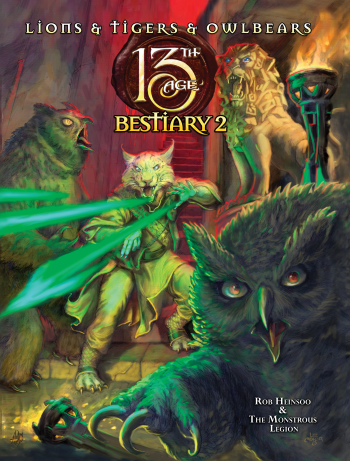
And speaking of 13th Age Glorantha, that’s the book where we introduced elite creatures, creatures that are half again as tough as a normal monster of that level. That power level felt exactly right for the Thanatar acolytes—and it’s telling that when I supplied the final hit points/numbers for Ruth Tillman’s similarly spooky jackal priests of the Great Ghoul in 13th Age Bestiary 2(page 123), elite status seemed right. The elite 150% mark is great for extremely dangerous combatants or leaders who you still want to encounter as part of a larger group. Double-strength and large monsters tend to eat up the building-battles possibilities while elite creatures supply some of the same punch while appearing in threatening numbers.

That’s the point of having monsters at different strengths at the same level: to give GMs flexibility when building battles. Well-built battles tell different stories, stories that feel much different when fighting mooks, weaklings, elite, large, or triple-strength enemies. Variable strengths work along with monster-level to provide multiple dials we can adjust each battle and each adventure.