Tuesday, December 10, 2013

Numenera and the History of Plunder

I had a wonderful time at Dragonmeet and in London with the Pelgrinistas. One of the happy discoveries on returning home is that my 13th Age co-designer has a a guest blog ready to roll. Over to Jonathan.


Now that Bruce Cordell’s and Monte Cook’s Kickstarter campaign for The Strange is over, we can once again pay attention to Numenera, Monte’s new RPG about exploring the mind-boggling world of the far future. Numenera is remarkable for, among other things, its emphasis on loot. The game is explicitly about exploring the mysterious world and recovering wondrous artifacts from ages past. Many of these devices are powerful enough to influence the course of a game session or campaign. They’re game-changers. In some ways, this emphasis is a return to original D&D and a reversal of a general trend in RPGs away from loot. 

In original D&D, there was precious little to differentiate one fighting man from another, other than magic items. Fighters had no skills, powers, or tricks, just stats. But loot found in the dungeon made one fighter different from another. An elven cloak made one character invisible, while a necklace of missiles let you throw fireballs. Magic items dropped randomly, based on big percentile tables, so they could be disruptive. The level of a treasure determined the chance it included a magic item but did not influence which random of magic item you found. If a low-level character randomly found a big magic item, it changed the game’s dynamics. The party could now take down monsters that had outclassed them or avoid obstacles that would otherwise have stymied them. Our campaigns were thrown off-balance, but it sure was fun to cut loose with overpowered magic items. 

With 3rd Ed, Monte, Skip, and I rationalized the random tables, categorizing magic items as mundane, minor, medium, and major. The idea was to reduce the disruptive effects of magic items, making loot less of a factor in differentiating characters. Even so, there were plenty of ways for magic items to have a big impact on play, especially anything that let you go invisible, fly, or otherwise substantially change the fundamentals of combat and dungeoneering. In 2007, Fourth ed took normalization even further. Magic weapon abilities, for example, were all made modest enough that each one was less valuable than an additional +1 on attacks would be. A +2 weapon with no ability is better than a +1 weapon with the best ability. That approach ensures that the weapons’ special abilities can’t disrupt game balance. Thirteenth Age follows this logic as well. Outside of the F20 tradition, loot has generally been even less important. My own RPGs (Ars Magica, Over the Edge, and Everway) have little loot to speak of, and you see much the same in Champions, Call of Cthulhu, Vampire, Feng Shui, and other significant RPGs. 

An exception that proves the rule was my slim RPG Omega World, a d20 take on Gamma World. I created that game specifically to recapture some of the disruption that had been balanced out of 3rd Ed. Omega World was meant as a change of pace, without the balance necessary to handle campaigns of indefinite length. Random good luck and random bad luck were built into the game’s DNA. Like Gamma World before it, Omega World was about characters with strange powers exploring a mysterious, fallen world, hoping to find powerful artifacts from ages past. Which brings us back to Numenera.

Numenera takes loot to the next level. The very title of the game refers to the unfathomable technology left over from eight past “worlds.” Here, game-changing loot isn’t a problem to be moderated. It’s the core of the game. How do you get over-the-top loot without knocking the campaign off-balance? Monte squares this circle by giving each item limited uses, often one. Using crazy loot is part of the game, but the action doesn’t spiral out of control. Monte has preserved for us something that most RPG designers have left behind—preserved it and advanced it. It’s exciting to see Monte bucking a nearly universal trend and giving players an experience that’s hard to find elsewhere. Numenera successfully advances classic roleplaying tropes in ways other than loot, such as character identity and dungeon crawling, but discussion of those will have to wait for future posts.

--Jonathan Tweet

Tuesday, December 3, 2013

Night Eternal

Reading early reviews for my new card game, Night Eternal: the Game, has been amusing and educational.

The game is from the backstory of the True Blood HBO series. When I say backstory, I mean way back, back to the late Middle Ages when the vampires' world was split between two factions, the ruling Authority and the Monarchy, former rulers who clung to older and more overly violent ways. This isn't a game about Sookie Stackhouse and vampire lover quadrangles. It's a game of cutthroat Medieval-vampire politics.

Several reviews have noted that the game has similarities to Three-Dragon Ante (3DA). True. Also, apparently to Richard James' Lords of Scotland, which came as a surprise to me since I'd missed that Lords of Scotland from Z-Man is a game with mechanics partially inspired by 3DA.

I originally designed Three-Dragon Ante (3DA) to be a sort of anti-poker, a quasi-gambling game that used micro-rewards and kept everyone playing instead of encouraging constant folding. 3DA lacked wagering dynamics and didn't do much with bluffing. Night Eternal starts with mechanics similar to 3DA but structures them around a contest for two separate pools of blood each battle, one from the Monarchy and one from the Authority. You can only win one of the two blood pools and one of the two starts double the size of the other. Consequently, bluffing about which prize you're aiming at is a big part of the game's strategy. Micro-rewards compete with temptations to go for the two macro-rewards.

Corey Jones of Cryptozoic wanted this game to be something that the vampires of the world of True Blood played to stay in touch with the past. In the old days they probably played it using humans as currency. So another design theme is that the game is a bit nasty, especially the abilities of the Immortals cards, unique vampires that come out of a deck that's separate from the normal Agent cards. Get hold of a few Immortals cards and you've got a shot at springing a nasty surprise on the opposition, but to obtain the Immortal you either had to play low or play smart. The one friend who I won't recommend the game to recently told me that her three children had finally learned how to play games together without fighting. Night Eternal is the wrong game for that family until they have a couple more years of gaming-without-conflict under their belt.

I'll have more to say about the game, here and elsewhere, but at the moment I'm about to get on a plane to fly to London for Dragonmeet. So I'll finish with a couple promo card images from the artist, Kieran Yanner. Yes, if you're an RPG fan you've been seeing Kieran's splendid work in Numenera. I was thrilled to find that he was the artist for Night Eternal.


Wednesday, November 27, 2013

Games Games Games

RPGs, 13th Age: 
I had a lot of fun finishing the new drafts of the monk and the commander classes for 13 True Ways. They're going out to the Kickstarter backers and the Escalation Edition purchasers and people who bought the 13th Age Bestiary pre-order. I believe they'll go out before the end of the week as part of the Pelgrane Press Page XX process.

Both classes will benefit from playtesting, especially the commander since this is its first iteration. Playtest notes definitely count. My last step with the monk was to reread all the playtest email we received at 13thAgePlaytest@gmail.com and check off each item as accounted for or at least considered.

Meanwhile in our Wednesday night campaign, the players have started calling me "Agemaster." It appears to be especially amusing to them when they're being helpful, or seeking favor, or sincerely trying to get my attention through the tumult of the room. They're also doing it because it irritates me a little. Perhaps because I'm the oldest human in the room. Perhaps because I'm not that fond of inventing new names for well-understood terms. It's not like I actually want this term to catch on. But it has gone on long enough that they're now shortening it to AM. I can't very well escape it and I suppose it also works if you're playing Dragon Age. So if amuses you, you're welcome. Yeargh.

RPGs, Thornwatch: 
We played one session of the in-development fantasy rpg created by Mike Krahulik of Penny Arcade. A delightful experience. I don't speak any French but there's a French word I love, bricolage, which may or not mean what I think it means: putting together pieces of everything to assemble something new. Thornwatch is a bricolage game, assembling elements of rpgs, card games, and deckbuilding games into something unique. It's not trying to be a do-everything rpg, it's trying to be a specific game experience you'll play when the time is right and when there are new things you want to try. The initial design is excellent. I'm a sucker for the-world-is-forest narratives. I love the Thornwatch/Lookouts stories and art. This should be really good.

Digital, Dwarven Delve: 
Down below where only fungus grows, my gaming group comrades have mounted another assault on their Dwarven Delve Kickstarter game. They've got an excellent playable demo to show where they are headed and they're getting extremely close to Kicking, a couple days left and not much farther to dig. When they Kick I'm definitely going to thank them for calling me Agemaster by introducing them to 13th Age versions of their own monsters in our Wednesday night games.

The Face in the Frost, the gang from the tube

I finally read John Bellairs' The Face in the Frost last week after owning and ignoring the book for decades. Why did it take me so long? Maybe glancing at the book's cartoons as a youth turned me off for no good reason other than being tired of reading about friars and monks. Not much of a reason, but that could have been it, and when you have a book forever it's easy to forget that you could get around to reading it instead of finding something new.

John Rateliff reminded me of the book's existence a couple years ago when we were talking about the history of fantasy for the permanent Fantasy exhibit at the EMP. Then a couple weeks ago, reading John's review of an Ursula Le Guin talk he attended in Seattle, I was reminded of The Face in the Frost again, a connection that made sense when I pulled the book out of a downstairs shelf and found Le Guin's admiring quote on the cover.

The Face in the Frost reads quickly and still feels substantial. The story has held up remarkably well for a fantasy written in the 60s. It's quirky, it's charming, it's dead-scary serious. I liked it a lot.

As I was reading the book last weekend, pressed to the glass of a door on Seattle's light rail train, there was a moment when reality and The Face in the Frost darted past each other. In the book there's a confrontation with a shouting wizard during a crossover between worlds of fantasy and the world we know as real. On the Seattle light rail a heavyset Filipino man burst out of his seat and shouted down an older African American man who had been talking quietly to someone else in a seat a couple rows back. "Hey! F*** you man! I'm a member of the Sons of Anarchy! I'm sick of people disrespecting us!"

"Alright, man, alright," said the older guy, slipping out of his seat and out the train's door, which had luckily just opened at a stop in a south Seattle tunnel.

I took a few seconds to watch as the ranting gang-man stalked back to his seat. I turned back to the war of magic in my book. Then I tried to connect the dots in the real world scene I'd just half-witnessed. I thought the Sons of Anarchy was a TV show about a fictitious biker gang? Who, if anything, really piss off the Hell's Angels? So this would have made a lot more sense if he had been yelling that he was a Hell's Angel. Which he didn't. Which means this guy a few seats down identifies himself as a member of a television biker gang? Oh. He's really crazy.

Or have the Sons of Anarchy crawled out of the tube and turned into a real gang in Seattle? Which is also crazy, but it's socio-cultural crazy involving the blurred line between tv-shows and and tv-reality-shows instead of just personal batshit crazy. No answers, unless I wanted to move up a few rows and ask the Son of Anarchy about his gang affiliation. So I went back to my fantasy book about blurring lines across malleable realities.

Tuesday, November 19, 2013

Kicking the Strange

Roger Zelazny's Amber series and side-doors in Moorcock's Elric books started my love of reality-shifting adventures. John Ostrander's Grimjack comic book series made good on the genre's promise. Years later I started serious work in the roleplaying game industry as a writer and editor on Nexus: the Infinite City, the genre-scrambling predecessor of Feng Shui. 

So I'm tickled that my friends Bruce Cordell and Monte Cook are teaming up on The Strange, a multiversal project that cleverly promises to portray the characters' world-hopping through character sheet power-set transformations  based on my favorite part of the Numenera system, the character statements. But never mind tickling my personal fancy, Monte's Kickstarter projects define how successful Kickstarters should be run . . . and at how extremely successful Kickstarters end up offering almost-but-not-quite-too-much value to backers. 

The Strange is in its last three days on Kickstarter. The pile of alternate-world loot that's headed to backers is growing hour by hour. Today's updates include The Paradox Room, a nifty introductory short story that I've been looking forward to seeing in final form since Bruce brought it to our writing circle. 

Professionally, I'm looking forward to the new game. Personally I'm so happy knowing that Bruce is going to be spending his next year working on something this much fun.

Friday, November 8, 2013

13th Age update: Commander, Monk, Playtest Files, Dragon Kings

This week's playtest of the new commander and the half-revised monk went well.

Commander
In the commander's case I didn't make any changes after the playtest. Partly that's because the design is in OK shape for now. Partly it's because Thorinn, the 5th level dwarf commander who used to be a bard, was hapless. He had no hap. When you're rolling d20s, playtesting every so often devolves into "Wow, so this is what the character class looks like when you suck." The dybbuks who had possessed the party's erstwhile paladin friend turned out to have Mental Defenses that deviated from the monstrous norm and even the commander's last-ditch outmaneuver attempt came to naught. The class design mission is to somehow make even these sucky moments potentially worthwhile.

The potential doesn't always get realized. Thorinn has had a slightly rocky road since he transitioned out of being a bard. Weird things happen when your story-oriented 13th Age campaign is also the campaign that's being used to test all the new classes. Thorinn who was once a bard became a bardmander and is now a full-on commander who is likely to shift even more when we adjust for results of public playtesting.

Monk
There will be a new playtest document some time next week. The talent half of the monk is revised, the forms half is still underway. Some of the early monk talents worked so well that the rest of the talents were somewhat irrelevant. The monk could vary from hugely powerful to utterly feeble because the talents and forms were so uneven. That's not entirely surprising, given that the class hasn't had an official development pass, but I'm trying to avoid it on this pass. The next version of the monk design aims to make all the talents worthwhile, eliminates one of the pieces of the class that wasn't working (daily options for finishing attacks), makes ki powers a more integral part of the class (instead of only appearing as feats), and opens up some of the unnecessary restrictions on icon relationships and weapon choice and flavor that were getting in the way of character design. Those of you who sent playtest comments? Your comments helped a lot.

Playtest Distribution Plan
As before, we'll be sharing the monk & commander playtest files with people who bought the 13th Age Escalation Edition and people who supported 13 True Ways. We're also planning to go one step further. The publication of 13th Age has brought in many new players and GMs. People are writing us every week asking to help playtest, particularly people who seem to be converting over from other systems and want to know how we're handling classes that aren't in the core book. We've settled on a cunning plan that seems fair. People who pre-order the 13th Age Bestiary by ordering the Hatchling Edition will also get the 13 True Ways playtest files. If you've supported us by buying the Bestiary in advance, you'll see the playtest versions of the new classes and whatever else we decide to send out for wide playtesting on 13 True Ways.

A Different Kickstarter
There's another Kickstarter with 13th Age connections surging towards the finish line this week. Timothy Brown's Dragon Kings project is a campaign world and rock and roll project in the spirit of Dark Sun. The project is funded and is presently a few thousand dollars away from a stretch goal that would create a 13th Age-compatible rules PDF as part of the package. Darren Pearce is the designer slated to tackle the 13th Age aspect of the project and I'd love to see what he comes up with. Give the project a push if you can.

And elsewhere in video
Mike Shea interviewed me about 13th Age for Critical Hits earlier this week. The first half hour or forty minutes is a discussion of icon relationship rolls, including verbal notes on advice Jonathan and I will be formalizing in the GM chapter of 13 True Ways. The video amounts to working notes on the topic. Other topics include the formats of upcoming adventures and Heisenberg's Monster, Mike's wonderful term for the sense in which 13th Age frees GMs up by allowing them to be surprised by what comes out of the box.

Tuesday, November 5, 2013

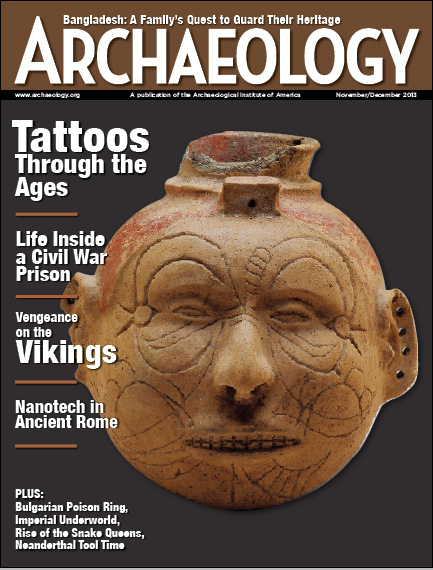
For inspiration: Archaeology magazine


The most recent issue of Archaeology magazine, November/December 2013, has four pieces I found inspirational.

An Imperial Underworld details the network of roads that cavers have been uncovering underneath Hadrian's Villa, 15 miles east of Rome. There was an upstairs/downstairs dynamic in play here, where upstairs was a world of palaces, libraries, baths, and gardens, while downstairs was a network of tunnels that kept things running smoothly and silently. The cavers recently found underground roads 19 feet wide, wide enough for ox-carts traveling both ways. I'm planning to use these ideas in Axis somewhere and I loved the hint of interplay between the enthusiastic cavers and the stuffier people running the site.

Later there's an examination of how at least one ancient Roman glass workshop mastered a type of nanoartistry, suspending gold particles in glass so that an apparently opaque cup changes color based on what light or liquid is in or behind it. Then there's a Bronze Age Mystery in which perfectly useful boats (and a couple old ones) are sunk in boggy East England rivers. Along with a few other excellent articles there's a look at ten ancient tattooing traditions. And finally, on the last page, a wonderful look at what appears to be a ceremonial shield from the Moche culture of Peru, constructed like warriors' shields but made of reeds and yellow feathers!

Definitely an issue worth looking at . . . . unless you lack the willpower to resist the magazine's bizarre medley of golden oldie and odd collectible advertisements, highlighted this month by "The only Cuckoo Clock inspired by the Wonders of Ancient Egypt."